1450W Magnetic Drill Press: Variable Speed, 1.6in Bore
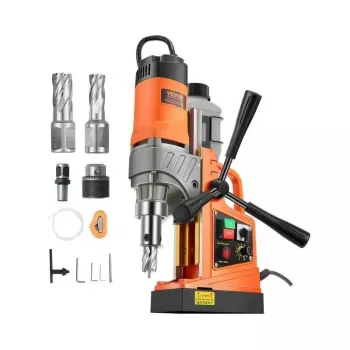
1450W Magnetic Drill Press with Variable Speed and 1.6in Boring Capacity
A magnetic drill press is built for fast, accurate holemaking on steel where a handheld drill struggles—especially on vertical or overhead surfaces. This 1450W model pairs a strong magnetic base with variable speed control and up to 1.6-inch boring capacity, aiming to cover everything from clean annular cuts to controlled drilling in tough material.
What This Magnetic Drill Press Is Designed For
- Portable drilling on steel beams, plate, pipe, and structural members when a floor drill press is impractical.
- Annular cutting for large-diameter holes with less effort than twist drills.
- Jobsite fabrication and maintenance work where consistent alignment and repeatability matter.
- Vertical and overhead drilling with magnetic holding force (surface prep and safety setup required).
Key Features That Affect Real-World Performance
- 1450W motor output supports sustained cutting under load; pair with proper feeds and cutting fluid to reduce heat.
- Variable speed helps match RPM to cutter diameter and material type, improving finish and cutter life.
- 1.6-inch boring capacity suits common structural and fabrication hole sizes; verify shank/arbor compatibility for your cutters.
- Magnetic base stability enables hands-free control on ferrous surfaces; clamping and a safety chain remain essential best practices.
Specifications and At-a-Glance Details
Use the table below to compare the most decision-critical specs before choosing cutters, arbors, and accessories. Also confirm the available power supply and work surface type (ferrous vs. non-ferrous) to avoid jobsite surprises.
| Item | Value |
|---|---|
| Power | 1450W |
| Speed Control | Variable speed |
| Boring Capacity | Up to 1.6 in |
| Availability | In stock |
| Price | 329.51 USD |
Variable Speed: When It Matters Most
Variable speed isn’t just a convenience—it’s what keeps a magnetic drill press adaptable when materials, thickness, and cutter sizes change across a job. When you can dial in RPM instead of forcing a “close enough” speed, you typically get cleaner holes and longer tool life.
- Larger cutters generally need lower RPM. Adjusting speed helps maintain a reasonable surface speed and reduces chatter.
- Harder steels and thicker sections often benefit from slower speeds with steady feed to prevent work-hardening.
- Lower RPM improves control when starting holes or breaking through, especially on thinner material where grabbing can distort the work.
- Speed is only part of the outcome. Sharp cutters, proper lubrication, and consistent feed pressure do the rest of the heavy lifting.
Working Capacity: Getting the Most Out of 1.6 Inches
A 1.6-inch boring capacity covers many common structural and fabrication hole sizes, but results depend on how the cutter system is set up and whether the tool’s stroke and clearance match the job.
- Choose annular cutters for efficient large holes. They remove a ring of material instead of the full diameter, often cutting faster with less torque demand.
- If using twist drills, consider step drilling or pilot strategies. This reduces load, improves chip evacuation, and helps maintain a round, accurate hole.
- Plan for clearance. Cutter length, arbor height, and the drill’s available stroke must match the workpiece thickness and access constraints.
- For repetitive hole patterns, streamline setup. Mark-out practices and center guidance accessories can cut down rework and speed up layout-to-hole time.
Magnetic Base Setup and Safety Essentials
Mag drills earn their reputation on setup discipline. A strong magnet is only strong when the contact surface allows it—and when the operator treats it like a controlled machine tool rather than a handheld drill substitute.
- Clean the contact area. Remove mill scale, paint, rust, oil, and debris to maximize magnetic holding strength and reduce rocking.
- Use a safety strap/chain. Especially on vertical or overhead applications, backup restraint is a must even when the magnet feels secure.
- Don’t rely on magnet hold for non-ferrous materials. Use mechanical fixturing or a dedicated base plate strategy when the work surface isn’t truly ferrous.
- Manage chips and heat. Cutting fluid, chip control, and periodic clearing reduce binding, extend cutter life, and improve finish.
For broader safety context around guarding and hazard control, review OSHA guidance on machine guarding requirements and NIOSH’s overview of the Hierarchy of Controls.
Typical Use Cases
What to Check Before Buying
Product Option
For current pricing and availability, see 1450W Magnetic Drill Press with Variable Speed and 1.6in Boring Capacity. Confirm accessory needs (cutters, arbors, pilot pins, cutting fluid) before the first job to minimize downtime.
More In-Stock Picks
- 3-Level Modern Cat Tree with Scratching Pad, Cushions, Condo and Toy
- Golf Cart Bag with 14-Way Divider
- Gogo 1/6 BJD Doll with Big Head & Dimples
FAQ
Can a magnetic drill press be used on stainless steel?
Yes for drilling or cutting stainless workpieces, but the magnetic base must attach to a ferrous surface; many stainless grades have low magnetic attraction. When the surface won’t hold a magnet securely, use a ferrous backing plate or mechanical clamping, then run slower speeds with cutting fluid and steady feed to reduce work-hardening.
Do annular cutters work better than twist drills for large holes?
Often yes: annular cutters remove a ring of material, so they typically require less torque and produce faster, cleaner large-diameter holes. Twist drills can still make sense for smaller sizes, mixed materials, or when your setup doesn’t support the required annular cutter arbor—just match the tool to the arbor and capacity.
What causes a magnetic drill to slip during drilling?
Slipping usually comes from poor surface contact (paint, scale, oil, debris), thin material that reduces holding power, or uneven seating that lets the base rock. Excessive lateral force, dull cutters that chatter, incorrect RPM, and skipping a safety chain can also contribute—prep the surface, set the right speed/feed, and always use backup restraint on vertical or overhead work.











Leave a comment