Test Business Ideas Fast: Trendspotting to MVP Scorecard

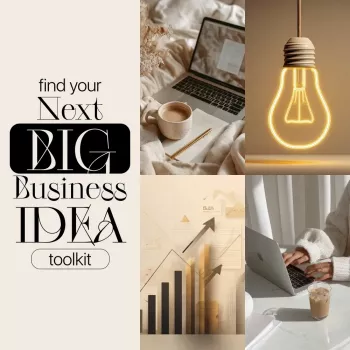
Some business ideas fail not because they’re “bad,” but because they were never tested against real-world signals: shifting customer behavior, obvious market friction, or proof that someone will pay. The Find Your Next Big Business Idea Toolkit (Ebook) is built for practical momentum—turning raw observations into a short list of promising opportunities, validating demand before building, and choosing the best option with a simple scorecard.
What’s Inside the Toolkit
This ebook toolkit is organized like a workbench: capture signals, shape offers, prove demand, then pick the winner with evidence.
- Trendspotting prompts to catch shifts in behavior, technology, regulation, and pricing
- Market gap exercises to pinpoint underserved audiences and broken alternatives
- Validation checklists that separate curiosity from purchase intent
- MVP test ideas designed to reduce risk before building the full product
- An idea scorecard framework to compare opportunities consistently
- Works for digital products, services, marketplaces, local businesses, and niche ecommerce
Trendspotting That Leads to Real Opportunities
Trendspotting gets useful when it’s grounded in observable signals and translated into “who benefits” and “what becomes newly possible.” Instead of chasing headlines, start with data and concrete changes.
- Scan for signals: rising search interest, new tools, workflow changes, policy updates, and shifting demographics
- Track second-order impacts: compliance needs, training, integrations, maintenance, support
- Look for constraint-driven demand: saving time, cutting costs, reducing risk, improving accessibility and convenience
- Filter every trend through one question: what becomes easier, cheaper, or newly possible—and for whom?
- Capture notes in a reusable format so idea-generation sessions start with real inputs
For fast trend research, Google Trends can help confirm whether interest is climbing, seasonal, or fading—useful when deciding what to test first.
Finding Market Gaps Without Guesswork
Market gaps often appear when customers are forced to “patchwork” solutions: a mix of spreadsheets, generic tools, DIY hacks, or settling for “good enough.” The toolkit’s exercises help map what customers do today and where those options break down.
- Map the current options: direct competitors, DIY methods, substitutes, and “do nothing”
- Identify failure points: high price, complexity, poor onboarding, missing features, slow delivery, weak support
- Find ignored segments: beginners, small teams, non-English speakers, specific industries, specialized workflows
- Use review-mining prompts to surface repeated complaints, feature requests, and hidden costs
- Turn gaps into a clear offer: who it’s for, what it solves, and the outcome it delivers
If market research feels overwhelming, the U.S. Small Business Administration’s guide to market research and competitive analysis is a solid reference for structuring what to look for and how to sanity-check assumptions.
Validation: Proving Demand Before Building
Validation is about reducing the biggest risks early—before time and money get locked into a full build. The toolkit focuses on evidence that requires effort or cash, not superficial attention.
- Define the riskiest assumptions: customer, severity, willingness to pay, acquisition channel
- Use fast evidence: conversations, pre-orders, waitlists, surveys with commitment signals, competitor traction checks
- Test comprehension: can the target buyer repeat your value proposition accurately?
- Set pass/fail thresholds: target conversion rate, qualified leads, or price acceptance
- Avoid vanity metrics: prioritize actions like booked calls, deposits, and intent-driven sign-ups
For a practical framework on testing ideas, Harvard Business Review’s guidance on business idea testing pairs well with the toolkit’s checklists and scoring approach.
MVP Tests That Reduce Risk Quickly
“MVP” doesn’t have to mean building software. The goal is to test the core promise with the smallest, fastest version that still produces real learning.
- Landing page MVP: test positioning, pricing, and targeting with clear calls-to-action
- Concierge MVP: deliver the outcome manually to learn workflow and expectations
- Wizard-of-Oz MVP: simulate automation and measure usage and retention
- Smoke tests: ads or outreach that validate demand before product build-out
- Pilot offers: small paid cohorts that fund learning and generate testimonials
- Measure what matters: activation, retention, referral intent, and payback indicators
Idea Scorecard: Choosing the Best Option Objectively
Sample Idea Scorecard (editable scoring example)
| Criterion | What to look for | Score (1–5) |
|---|---|---|
| Problem severity | Frequent, costly, or risky pain; strong urgency | |
| Willingness to pay | Clear budget owner; price tolerance confirmed via test | |
| Reachability | Known channels to find buyers (communities, search, outbound, partners) | |
| Differentiation | Unique angle, niche focus, better workflow, or measurable outcome | |
| Competition pressure | Crowded vs. underserved; ability to win in a segment | |
| Time to MVP | Days/weeks vs. months to test core promise | |
| Operational complexity | Support burden, fulfillment, edge cases, compliance | |
| Upside potential | Market size, expansion paths, retention and LTV potential |
A Simple Workflow for Using the Toolkit in One Week
Who This Ebook Toolkit Fits Best
Get the Toolkit
- Price: $25.99 (USD)
- Availability: In stock
- Product page: https://luvzon.shop/find-your-next-big-business-idea-toolkit-trendspotting-market-gaps-validation-mvp-tests-idea-scorecard-ebook/
Extra in-stock picks (useful for niche research inspiration)
FAQ
How is this different from brainstorming business ideas online?
It’s a repeatable system: you start with trend inputs, frame ideas as market gaps and clear offers, validate with commitment-based signals, run lightweight MVP tests, and then use a scorecard to choose based on evidence rather than inspiration.
What’s the fastest validation test to run if there’s no audience yet?
A landing page with a clear call-to-action (waitlist, pre-order, or booked call) paired with targeted outreach or a small ad budget is usually the fastest. Set pass/fail thresholds upfront so you’re measuring intent, not just clicks.
Do MVP tests require building software?
No—many MVP tests are low-build or no-build, such as concierge delivery, Wizard-of-Oz simulations, prototypes, and paid pilots. Building comes after the core promise is validated with real user behavior.











Leave a comment